

Jews being disloyal to Germany during WW1 was among many central claims made about Jews by Nazis after Germany’s defeat in WW1. At the same time, it was also a common belief during the war to a point that it prompted a national investigation: Judenzählung, whose findings were classified.
Now, I will not look at the Jewish-organized communist revolution in Germany 1918–1919 because I don’t think that anyone would seriously argue against this being a massive act of disloyalty. Instead I will look into the common claim of German Jews not fighting for Germany in WW1 to the same extent as Gentile Germans do.
Unfortunately because all records of the official investigation were destroyed during WW2, we can only rely on Jewish un-official side estimations for the numbers that go alongside the correct 1910 census data as well as Alfred Roth’s earlier estimation which were based on the leak of official estimations.
The often cited figure for Jewish population in the German Empire is 550,000 souls, however this does not include Jews who were not citizens of the Empire. When they are counted, the total number of German Jewish residents jumps to 615,000 souls. At the same time, because none of the Jewish residents were conscripted into the army, their number must be disregarded in favor of the 550,000 estimate of the citizen population as that is the pool of people eligible for conscription.
The estimation for Jewish soldiers fighting for Germany provided by the head of the Bureau of Jewish Statistics Jacob Segall comes at exactly 100,000 people. Funny enough there has never been another proper estimation besides Jacon Segall and the earlier Alfred Roth’s The Jews in the Army book which reportedly was acquired from a leak of Judenzählung’s findings.
The leak was real. When formally challenged, Reich Defense Minister Otto Gessler affirmed Roth’s numbers on 26 July 1920, in direct response to an official inquiry (Rosenthal 2007, pp.118–122). The figures were then independently corroborated two years later, when General Ernst von Wrisberg published the War Ministry’s own absolute totals for the 1916 census in the second volume of his memoir Heer und Heimat matching Roth’s so closely that historians conclude Wrisberg was the original source, having passed him the data in 1918/19 (Wrisberg, Heer und Heimat 1922, vol. 2; Rosenthal 2007, pp. 118–122).
Unfortunately No verbatim transcript of Gessler’s wording survives, which is why his statement has been read more than one way, most cautiously, as conceding that Roth’s findings were partially correct rather than wholesale accurate (Rosenthal 2007, pp. 118–122).
Speaking of which, here is how they differ:
Roth:
Jews total: 615,000
In service: 62,272
Jews at the front: 27,515
Counted: Jews in uniform on 1 Nov 1916
Dead: 5,000-6,000
Iron Cross I: 900
Iron Cross II: 17,000
Decorated: ~18,000
Promoted: ~2,000
Jews total: 615,000, out of which 550,000-555,000 draft eligible Jews
In service: 84,352 then extrapolated to 96,327
Jews at the front: ~80,000
Counted: Jews who ever served 1914-1918
Conscripted+volunteered: 100,000 (78,000 of whom fought at the front)
Dead: 9,216 dead + 873 missing, then extrapolated to 12,000 thousand.
of the roughly 84,352 Jews who fought at the front, 29,874 were decorated for bravery and 19,545 were promoted
Decorated: 29,874
Promoted: ~19,545
My own commentary is that neither figure could be trusted. Roth was a founder leader of a militant antisemitic organization who wanted to ethnically cleanse Jews out of Germany. Segall was a Jewish activist working for the Bureau for Jewish Statistics, whose explicit purpose was to improve Jewish reputation among Gentiles.
The methodological error in Roth’s number is that he counted the full Jewish population of Germany, including residents who were not eligible for conscription and most importantly had no access to data after November 1916. Segall inflated the death count and the decorations from an extrapolation of the available data.
The asymmetry is that Segall’s findings are quoted as authoritative numbers, despite the fact that he had no access to the military archives. Just the 1910 census and private post-war Jewish sources. Roth, was working with the Ministry’s real numbers as of late 1916 but did not have access to them in 1917 onwards.
Because of this, you have to look into other proxies and lines of evidence which may indirectly prove one estimate over another. Military awards is one such example.
Going by Roth’s numbers then out of a population of 550,000 Jews, 18,000 were awarded Iron Crosses for their service in WW1. Meanwhile the 99% of the German population had received 5.4 million Iron Crosses for their service to Germany out of a population of 65 million (so 64.5 million).
The per capita calculation is that one in 30.5 German Jews had received an Iron Cross for their service while among the remaining 99% of the German Gentile population, it was one in 11.9, which is close to Alfred Roth’s numbers. Going by Segal’s numbers its one in 18.4 Jews.
However there are some caveats to lower Jewish decoration, most notable, is that the chief reason could have been antisemitism. For example Between 1880 and 1910, up to 30,000 German Jews served in the Prussian Army, but none were promoted to the rank of officer. However, among the 1,500 Jews who converted to Christianity, 300 were promoted.
For instance, in a far-more antisimetic country to the east, 60,791 of Jewish soldiers had received decorations of one kind or another out of an estimated 5,6 million Jews which is 1 decoration per 92 people. However, just 25,474 of Jews had received the medal of St. George (the Russian equivalent to the Iron Cross) as of May 1917 which is 220 per medal. In total Russia had awarded over 1.5 million St. Georges for a population of 176 million people.
If we control it for mobilization, then 400,000 of the Russian Jews were conscripted into the Russian Army compared to roughly 14 million of Russian Gentiles. This gives us one medal for roughly 15.7 Russian Jews and one medal for 9.3 Russian Gentiles. This is strikingly similar to Segall’s estimation of Jewish non-inflated decorations rate.
On the other hand, during WW2, Soviet Jews became the fourth most decorated ethnic group in the USSR after Russians, Ukrainians and Belarussians, but not among those receiving the Hero of the Soviet Union medal.
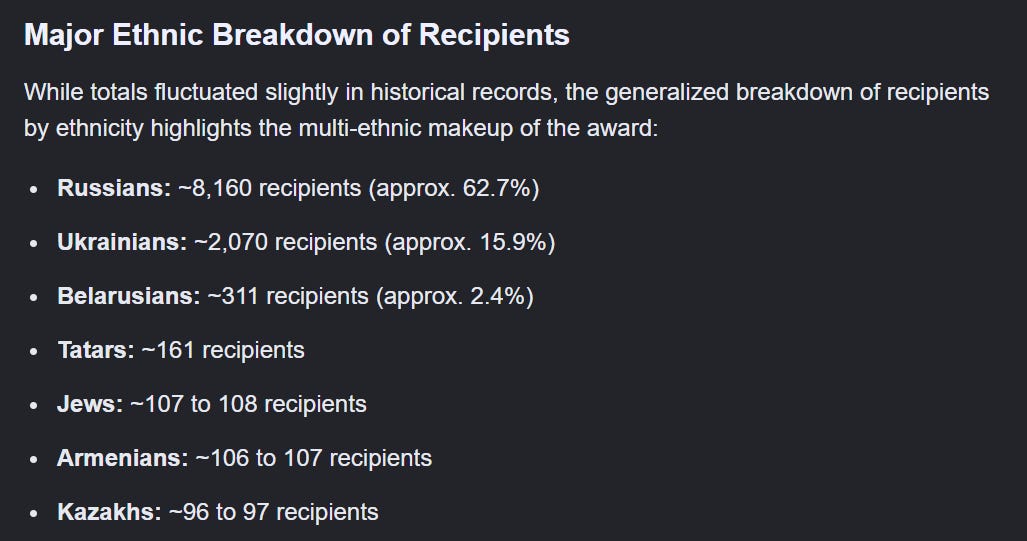
This is strikingly similar to the amount of American Jews who have received the highest military recognition (not many):

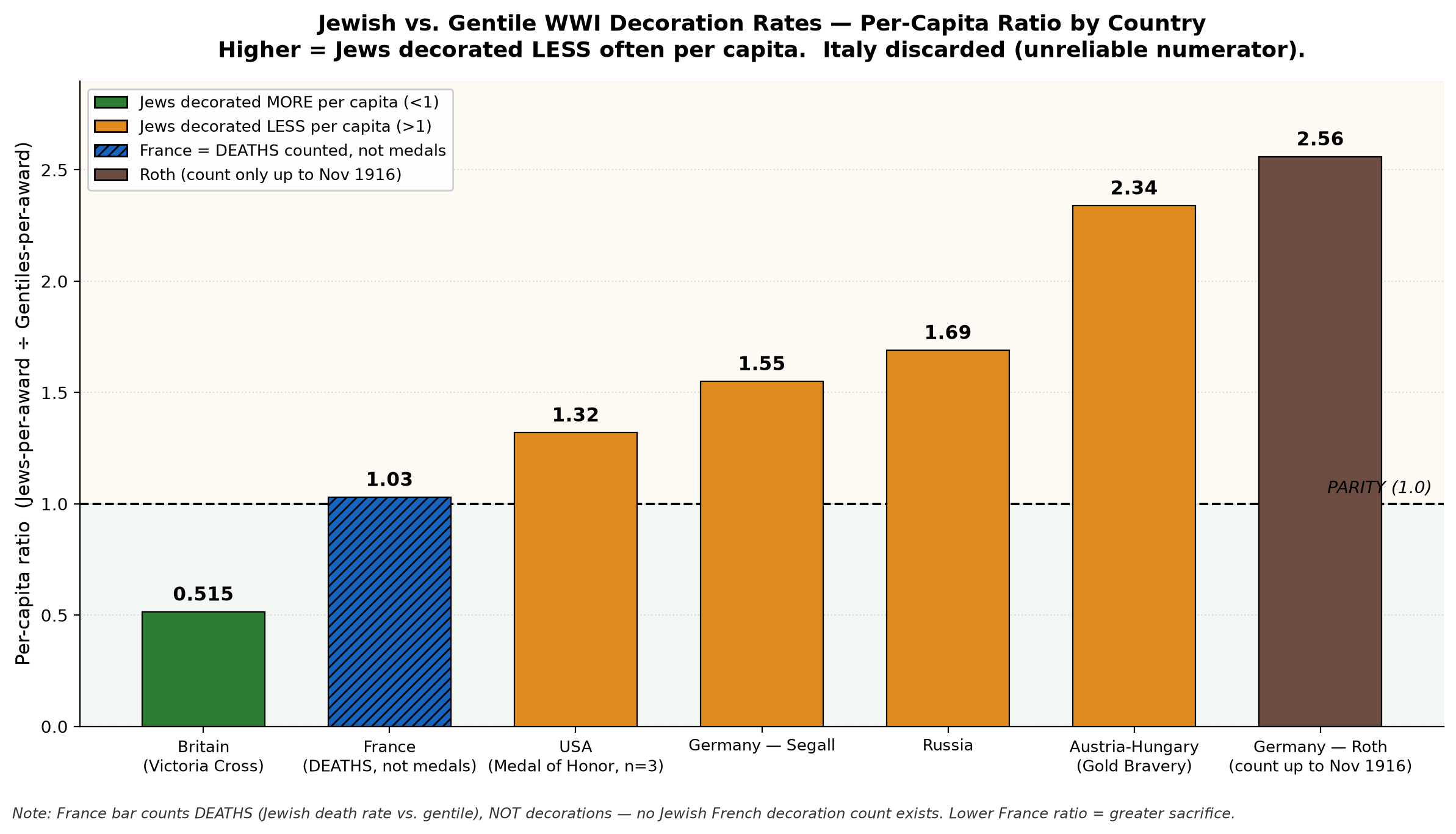
To further test this theory of antisemitism I decided to look up how many Jews were decorated for their service in other countries during WW1 and here is what I arrived at:
Austria-Hungarian Gold Bravery Medal:
One award per 31,645 Austria-Hungarian Jews vs one award per 13,532 Austria-Hungarian Gentiles. Ratio: 2.34
Among those who served: One award per 3924 Austria-Hungarian Jews vs one award per 2071 Austria-Hungarian Gentiles. Ratio: 1.89
Germany:
One award per 30.5 German Jews vs one award for 11.9 German Gentiles (Roth). Ratio: 2.56. And 2.41 is the per-servicemen ratio.
One award per 18.4 German Jews vs one award for 11.9 German Gentiles (Segall). Ratio: 1.55. And 1.45 is the per-servicemen ratio.
Russia:
One award per 15.7 Russian Jews vs one award for 9.3 Russian Gentiles. Ratio: 1.69. It is difficult to arrive at the per-servicemen ratio because there is no consensus on how many Jews have actually fought in the war. The number of Jews who fought in the war is anywhere between 350,000 and 600,000.
Great Britain Victoria Cross:
One award per 51,600 British Jews vs one award per 100,217 British Gentiles. Ratio: 0.515. And 0.7 is the per-servicemen ratio.
The data is all over the place. I also tried to find other stuff notably on France, US and Italy but the data is really, poor. France doesn’t keep proper records. The number ratio for Italy is 0.12 which is astronomically high and lacks a proper source. And just 3 American Jews had received a medal of honor coming at the per-serviceman ratio of 2.41 which is comparable to Roth’s estimate.
Perhaps the strongest correlation is between states perceived as antisemitic, but the United States is the exception here. Notably I noticed this passage as it relates to France, but these are not decorations:
Despite the Right’s belief that Jews were disloyal, of a population of 190,000 in 1914, 32,000 French Jews were mobilized and 6,500 died (1 in 5 in comparison to the 1 in 6.5 for the French).
The only problem with this is that at least 100,000 of Russian Jews died during WW1 along with 2.8 to 3.4 million Russian Gentiles (civilians included). I didn’t do the calculation because the data is really noise but I am pretty sure that this number beats the French one. That is of course assuming that’s true.
I honestly don’t know how to interpret all of this but I am leaning towards:
Jews are conditionally loyal. There are legitimate in-group discrepancies.
A lot of data is bunk to draw meaningful conclusions, notably: France, Italy, Russia, and I have already provided plenty of commentary as it relates to Germany’s data. Best data we can infer from is Austria-Hungarian and British and it pretty much confirms my thesis.
Form your own conclusion
Here is the final graph:
I tried looking into this some years ago before AI but wasn't able to make much progress. Eysenck claimed Jews were decorated at a higher level in one of his books, probably the autobiography. Doesn't seem true and Eysenck in general was dictating books from memory. Impressive as that was, it's not the most reliable method.