

Physiognomy is the practice of assessing a person’s character or personality from their outer appearance. In simpler terms or as Prosopa Insights summarizes: external appearance of things indicate their function.
I have spent a good portion of my free time in trying to verify some of the claims that are being put out by proponents of physiognomy
This will be a buildup and a review of this article on physiognomy as well as the claims of Prosopa Insights, Edward Dutton and others.
The TLDR is that Physiognomy is true only for as long as it is subjected to rigorous scientific testing and that the popular conceptions on physiognomy as are manifested in videos by Prosopa Insights are largely false.
First I’d like to make note of the fact that external appearances do indicate of the internal state in some degree with humans. Here for instance is the typical facial profile of an autist (which is a neurological disorder).
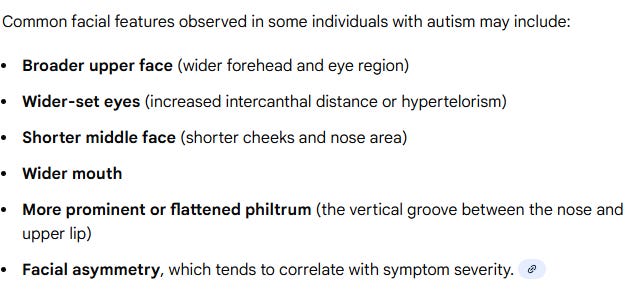
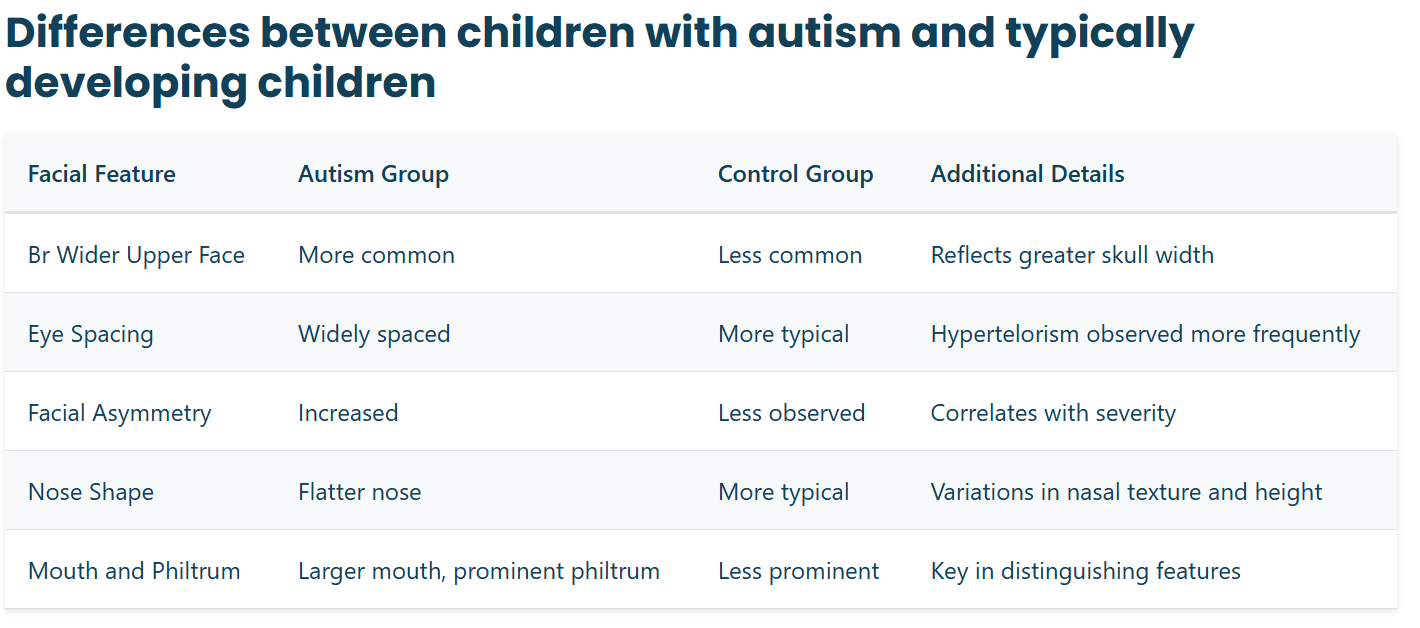
The claimed accuracy of this in estimating the autistic phenotype over 80%. So let me know if you’re autistic and possess all the facial features that are listed here or if you’re not autistic but possessing them. I scored 5/6 and I’m not sure if I’m autistic.
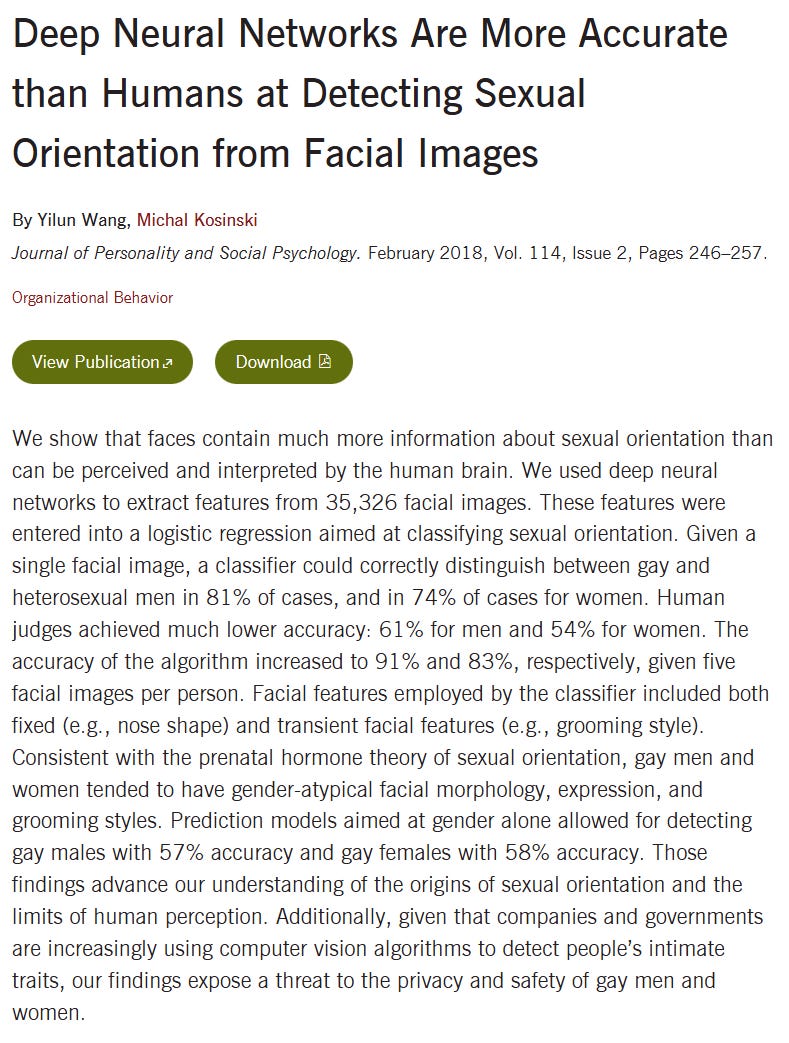
Physiognomic approach is most highly pronounced (over 90-99% accuracy) with detecting physical abnormalities that are indicative of rare genetic diseases, but it works much poorly on the general population where phenotypic variation may be minimal despite a significant psychological and intellectual variation. For examples, when it comes to predicting sexual orientation it never goes above 80% accuracy, while the advanced AI estimations of Big Five go like this:
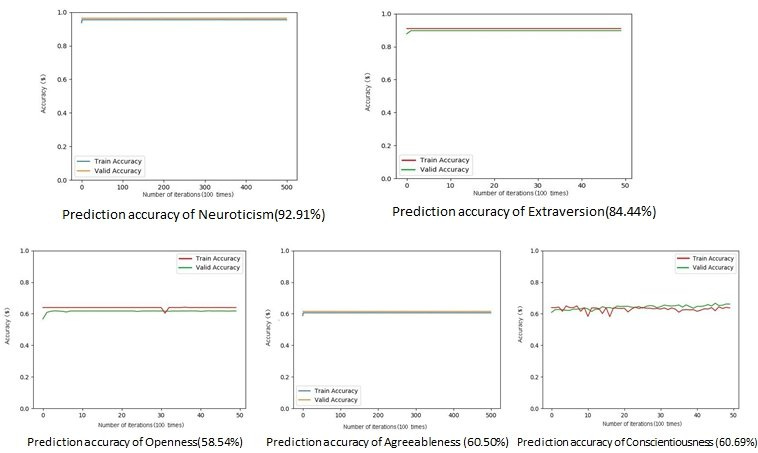
The bottom three personality traits don’t give any significant visual cues yet they are also important, especially as they relate to pro-sociality. Still, even with an accuracy of around 70% that would still be a correlation of up to r=.36 on a static image and up to r=.42 when the advanced AI counts 70 key points of the face, which is still lower than the correlation of a professional non-AI clinical evaluation of Big Five traits.
Here is for instance a portion of my pay-walled material concerning intellect, if you pay close attention, the effect sizes and correlations are small and thus are overall less predictive than an objective psychological or intellectual evaluation:

The only significant correlation is the MRI brain scans, but the problem with that is that they cannot be properly estimated by just looking at the head or face. You cannot determine the exact internal structure and size of the brain simply by looking at the head or even measuring it.
Obviously, it goes without saying that the correlation between an IQ test and g is around r=0.9.
In otherwards, physiognomy tends to be correct in terms of measuring mutational load and neurological disorders, especially at the extremes, but when it comes to the general population or even celebrities as it is often used, it gives modest effects and only when you are using AI or algorithmically analyzing 70 facial features at once yourself somehow.
Now, my problem with physiognomy as it presently exists is the fact that it is filled with a ton of extraordinary specific psychological claims for which there is no extraordinary evidence. Instead of concentrating on genuinely measurable factors such as identifying genetic abnormalities, approximating cranial proportions, inferring testosterone levels from hair growth patterns, or assessing a person’s habitual mood through muscle contraction frequency, proponents of physiognomy often veer into unfounded and speculative claims like the “Venus face shape”, “Uranus face shape”, determining how someone is in touch with their inner word by the tilt of their lips and other bullshit.
For instance, I remember watching a video about eyes, only to discover that the correlation between myopia and increased visible sclera—both legitimately associated with higher intelligence was ignored, and instead the video made a series of unfounded assumptions about eye types and specific personality traits. Although I presume that he may have mentioned intelligence behind the paywall on Patreon, where he is making a considerable amount of money. Certainly if the AI accuracy of determining agreeableness or conscientiousness after analyzing 70 various facial features is marginally better than a coinflip, analyzing one part of the face independently and making specific conclusions is at best irresponsible speculation.
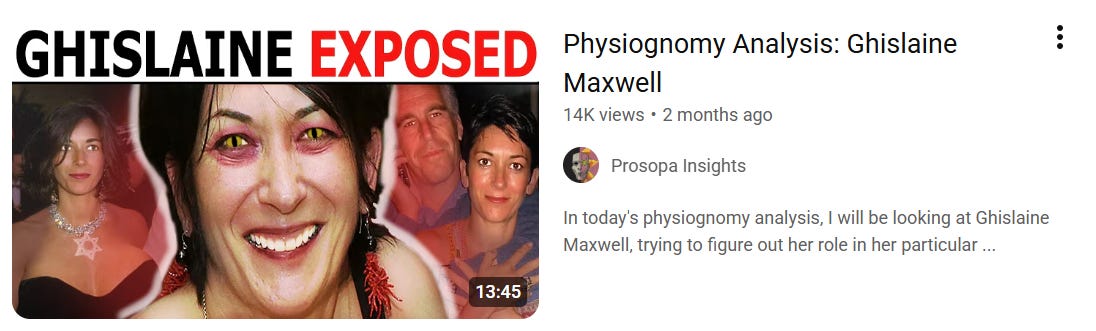
In a video concerning Ghislaine Maxwell I have likewise not seen any scientifically valid application of physiognomy such as fWHR proportions, exploration of asymmetry (proxy for mutational load), forehead proportions and eye size (estimation of her intelligence) and wrinkles on places of muscle contractions (estimation of her dominant mood). Instead the video was filled with “hot reading” of Ghislaine Maxwell’s crime story and the attempted connection of her facial features such as her smile, “Venus face shape”, the tilt of her lips, eyes and how set her eyebrows are. Clearly few of these things matter when their aggregate can’t give any meaningful results unless it’s neuroticism (a proxy for mutational load).
Obviously this is not a serious video nor is it a serious physiognomic analysis. It is what one would regard pseudoscience.
Now, it’s not always that these videos are filled with baseless speculations. Sometimes, things can sound convinced like the often repeated attempts to categorize someone’s face into one of the dominant four temperaments. But there is absolutely no evidence to suggest that personality types like “sanguine”, “melancholic”, “choleric” and “phlegmatic” can be predicted through facial appearance. Furthermore, there is no verifiable evidence that this is even the proper categorization of the temperaments that date back to Hippocrates.
The science of personality and psychology is already settled on the “Big Five” and the four temperaments aren’t being seriously considered, nor can they be determined by a visual appearance. At best, they’d be able to identify the melancholic and perhaps choleric types but only because they are a proxy for neuroticism and maybe extraversion.
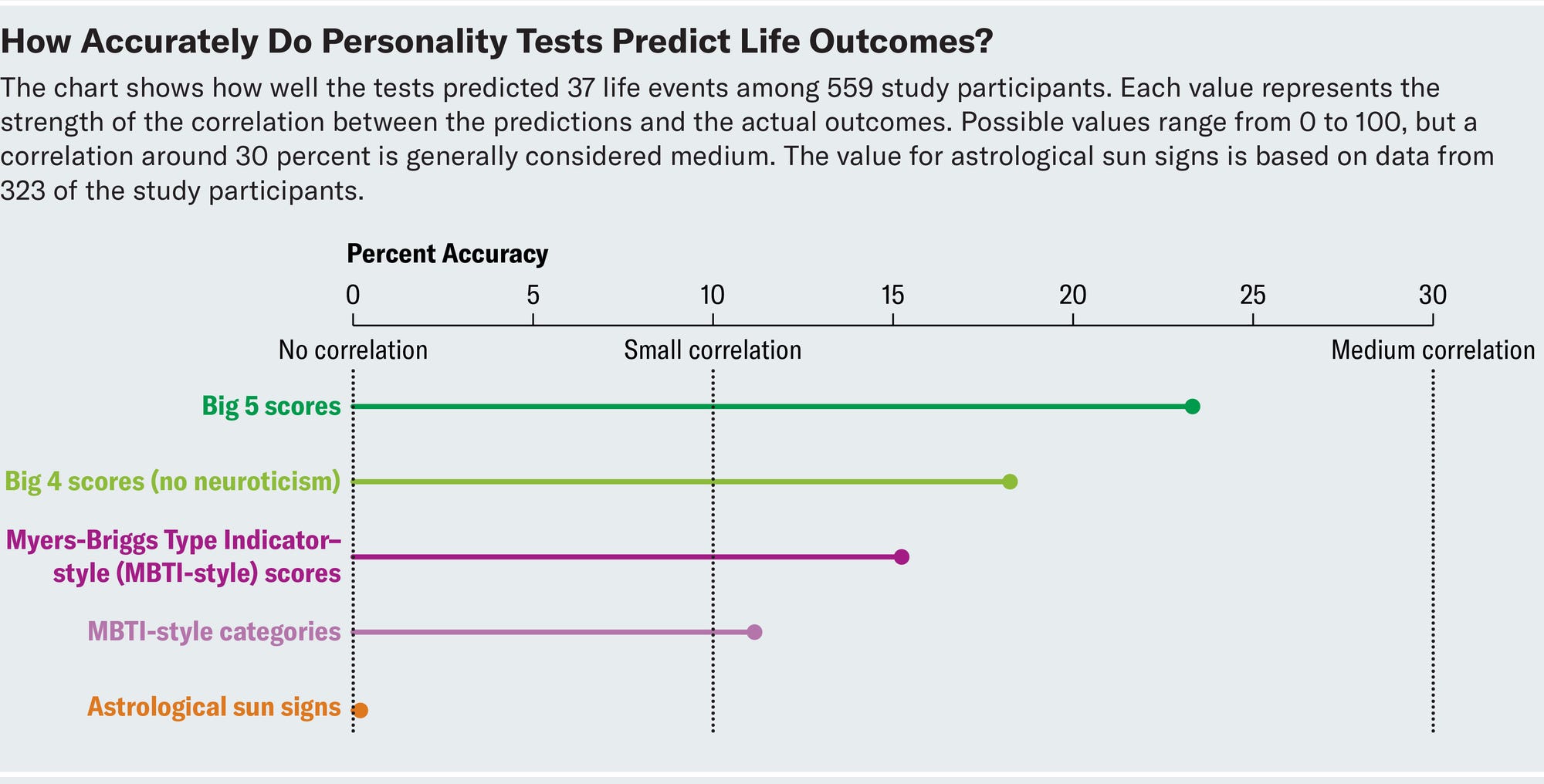
There is simply no academic literature regarding the validity of the “four temperaments”. A personality cannot be dumbed down to a one dimensional caricature. Instead the scientific approach to personality is of spectral variations in multiple factors like “neuroticism” or “agreeableness”. Four temperaments is astrology tier understanding of psychology.
If you watch Prosopa Insights’ videos they will be full with farfetched assumptions about specific personality traits like how a certain brow type correspondence to being indecisive but quick to act and yet with little to non objective assessments of physiognomy which may yield only modest results. If Personality tests and assessments sometimes struggle in determining the five general personality traits, determining specific personality traits inside the five is even a bigger task.
You have to understand the proper epistemological process of how to arrive at conclusions. If a supposed doctrine claims to be correct on ten points and is proven on four of five of them, while the remaining lacking evidence and at least three if not four of those even appear demonstrably false - you shouldn’t accepting the doctrine wholesale. The logical approach would only be to accept the points for which these evidence, and rearrange the doctrine in such a way as it is no longer claiming falsities.
That requires to adopt an empirical based approach to physiognomy which is what appears to be yielding results in many domains, but these results are modest, unless you count for obvious genetic diseases that are visible from the outside.
There needs to be a careful examination of every claim made by the proponents of physiognomy concerning personality and minor facial features like brow position or tilt using a large sample and so far there has been zero studies on that. Frankly I am skeptical they will ever yield any meaningful results independent of their combination with other body features.
It is certainly logical to assume that minor facial features may have some links with personality, but there are two questions that we must consider:
How do you actually measure it
How significant is the effect
For now facial features like nose, eye shape or ear shape are best predictive of an ethnic group and normal distribution, and perhaps abnormalities, definitely not of personality, unless they are looked at in their assembly. For as long as there are no scientific studies backing the wild and specific assertions, talking about facial physiognomy is irresponsible. “The Ancients” didn’t know better and neither do modern day esoteric obsessed chuds nor their gay and female colleagues from the astrology department.
So no, conventional and popular physiognomy are not real, but if you want to read the remaining 60% of the article in which I will list all the instances of scientifically validated links between personality and body features, you should become a paid subscriber.
