
How German was the Russian Empire?
A Quantitative Analysis

I have decided to do an overview of German influence in the Russian Empire ever since stumbling on this powerful AI generated table suggesting significant German overrepresentation in the Russian Empire that goes beyond the ruling dynasty itself.
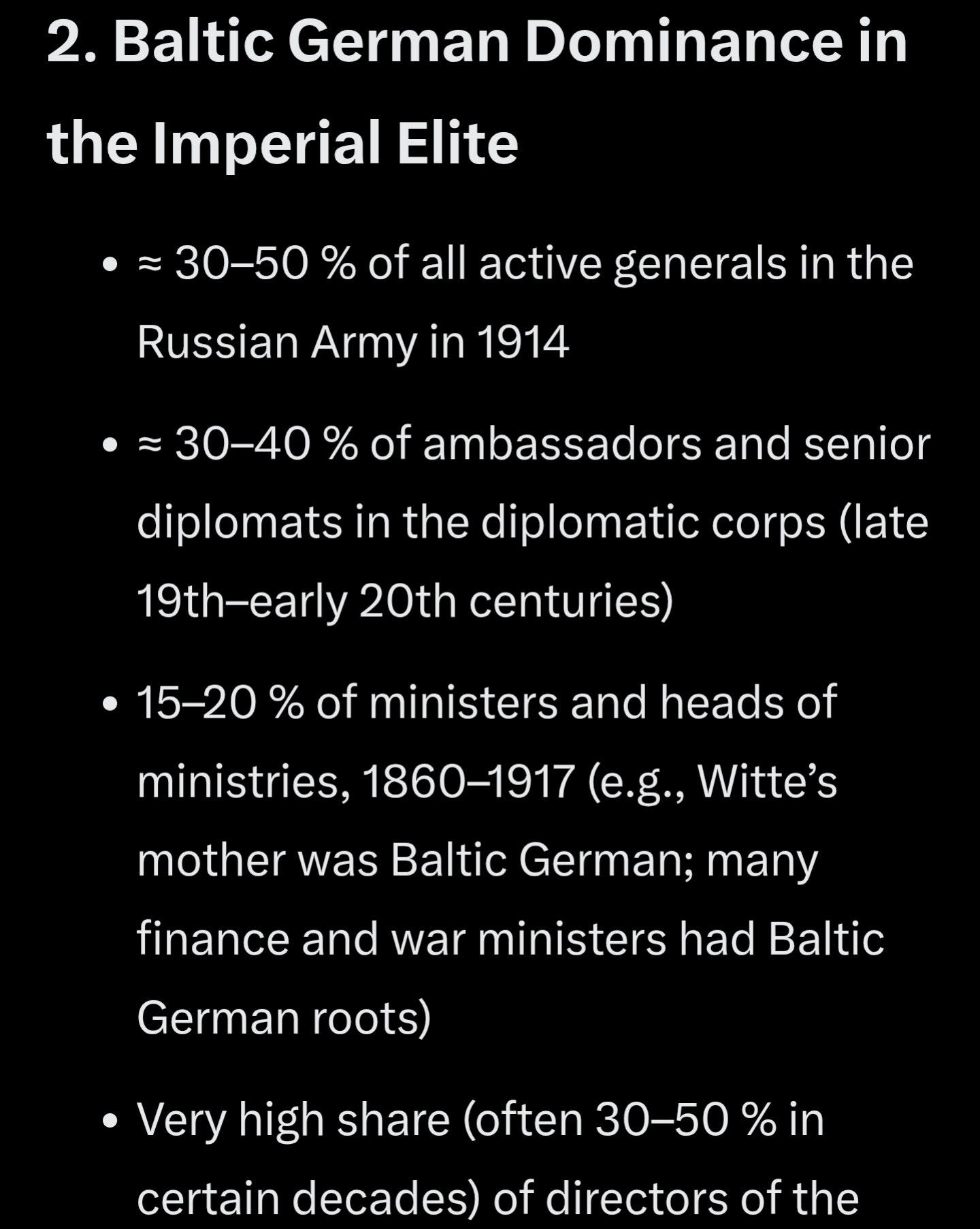
View this as purely a quantitative endeavor with no commentary. Perhaps I will eventually turn this into a bigger post or a YouTube video with my own commentary and conclusions, but right now I am simply documenting the research without any qualitative input.
The Army
I immediately set out to verify these claims, beginning with the military aspect. If Grand Dukes are counted as German, then during World War I, Germans comprised a striking 38% of the Russian Empire’s top generals. Vindicated?
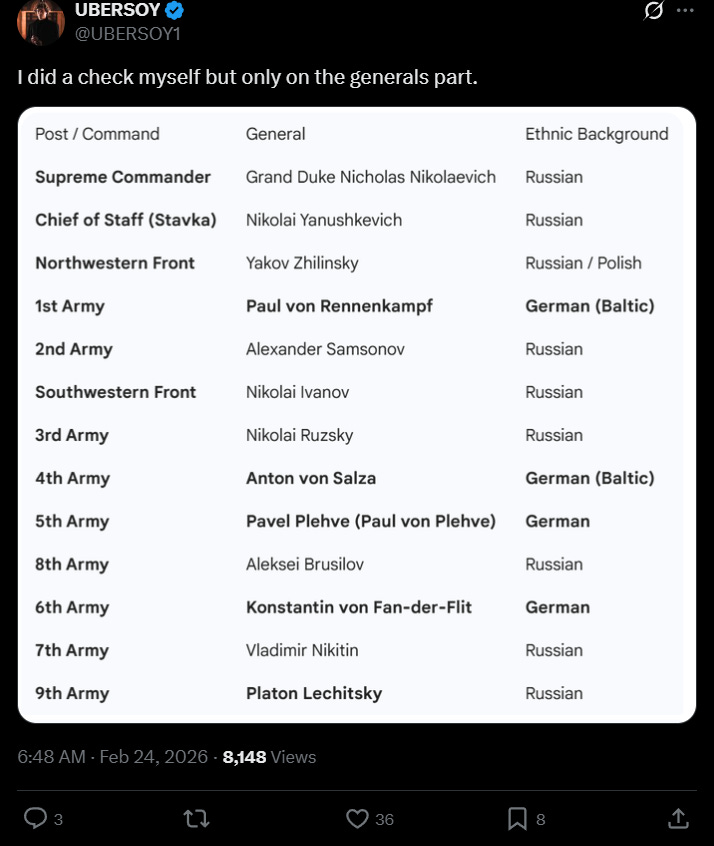
Here is how many Russian generals were of German descent in different periods of Russian history according to Claude:
Napoleonic era (1800-1820)~25-30% of generals
Nicholas I era (1825-1855)~20-25% of generals
Alexander II era (1855-1881)~15-20% of generals
Alexander III era (1881-1894)~10-15% of generals
Nicholas II pre-war (1894-1914)~8-12% of generals
Then I have decided to dig further and study Russia’s Civil War generals and here is their ethnic backgrounds:
White Army:
Anton Denikin — Russian
Alexander Kolchak — Russian + Moldovan/Turkic
Pyotr Wrangel — Baltic German
Lavr Kornilov — Russian + Asian
Nikolai Yudenich — Russian
Sergey Markov — Russian
Anatoly Pepelyayev — Russian
Roman von Ungern-Sternberg — Baltic German
Pyotr Krasnov — Russian, Cossack
Mikhail Alekseyev — Russian
Yevgeny Miller — Baltic German
Germans = 27% of the main White Army forces generals if you include Roman von Ungern-Sternberg as a White army general, 18% if you don’t.
Red Army:
Leon Trotsky — Jewish
Sergey Kamenev — Russian
Mikhail Tukhachevsky — Russian
Semyon Budyonny — Ukrainian/Russian Cossack (Don region)
Vasily Chapayev — Russian
Ion Yakir — Jewish
Ieronim Uborevich — Lithuanian (possible of Belarussian descent)
Jukums Vācietis — Latvian
Alexander Yegorov — Russian
Kliment Voroshilov — Russian
Mikhail Frunze — Moldovan + Russian
Vladimir Antonov-Ovseenko — Ukrainian
Pavel Dybenko — Ukrainian
Zero prominent Germans among famous Red Generals.
Then I decided to improve my methodology and instead of going based on famous ones I have decided to take a look at all of them combined using this database:
Using Claude for my counting I got the following results:
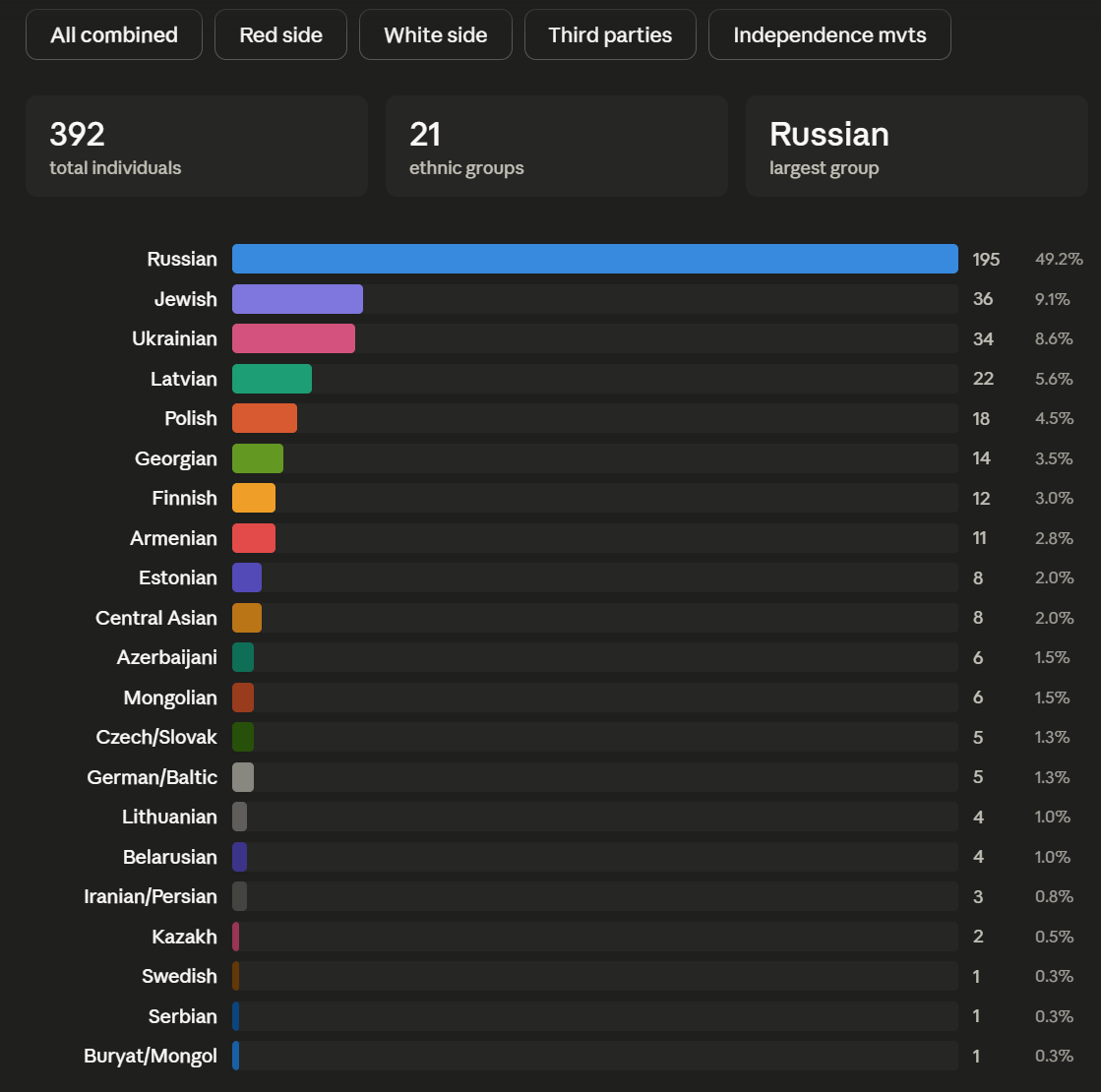
Here is how Red and White sides compare:
Red Side:
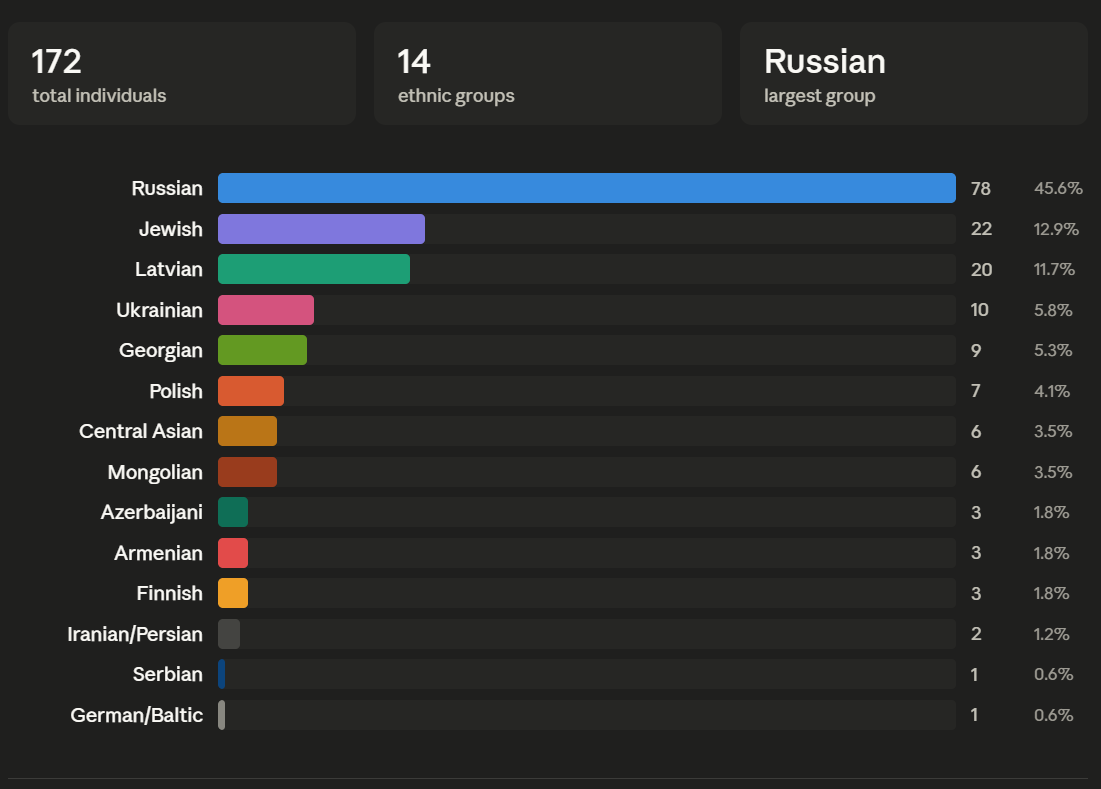
White Side:
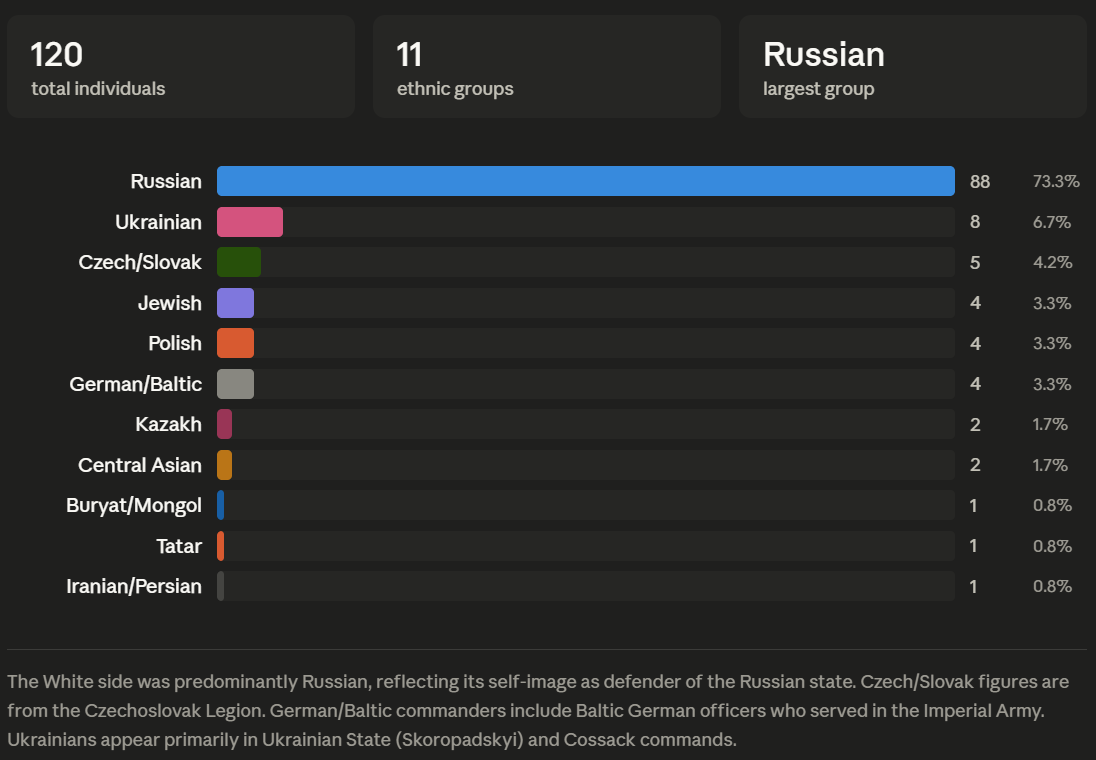
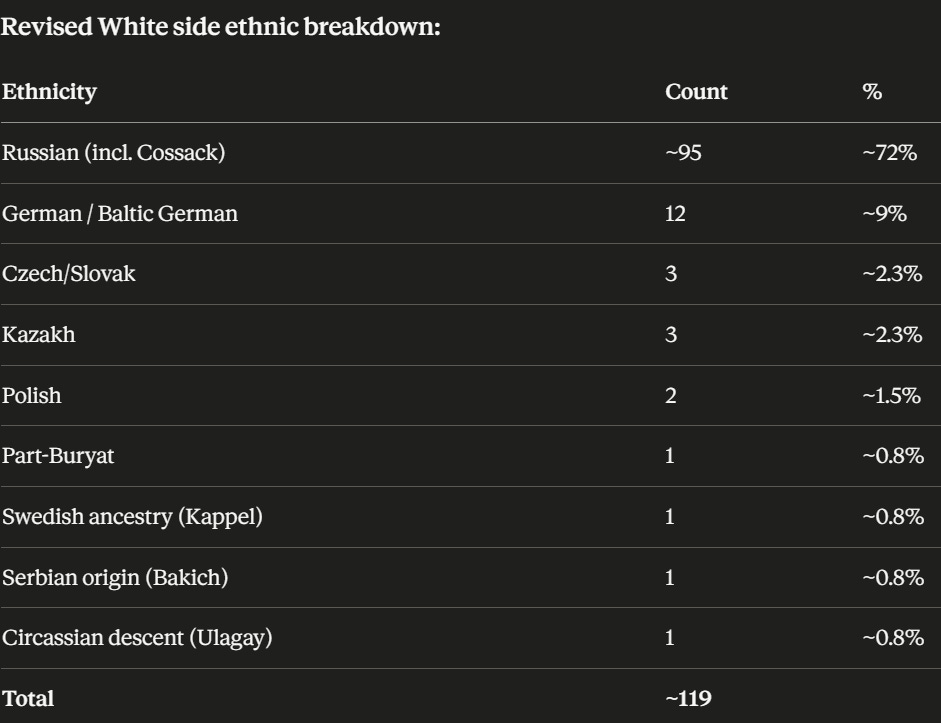
These lists didn’t add up to my own calculation and so I decided to look into the labeling and as predicted it counts many Germans as Russians because they were culturally assimilated.
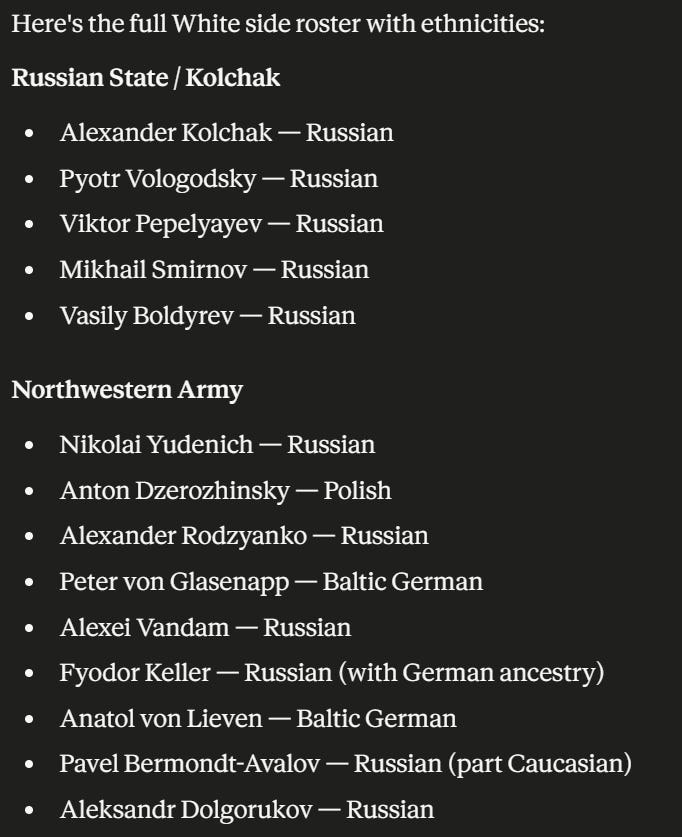
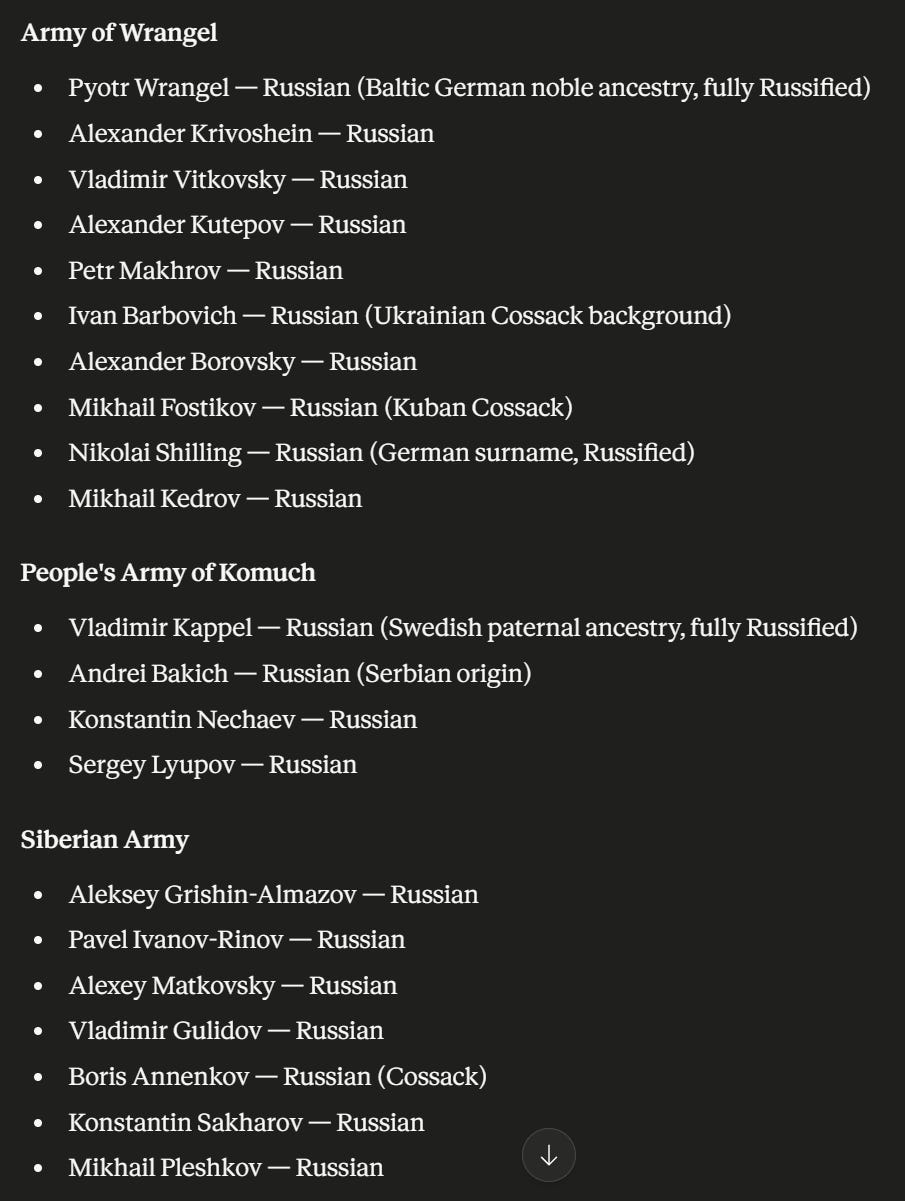
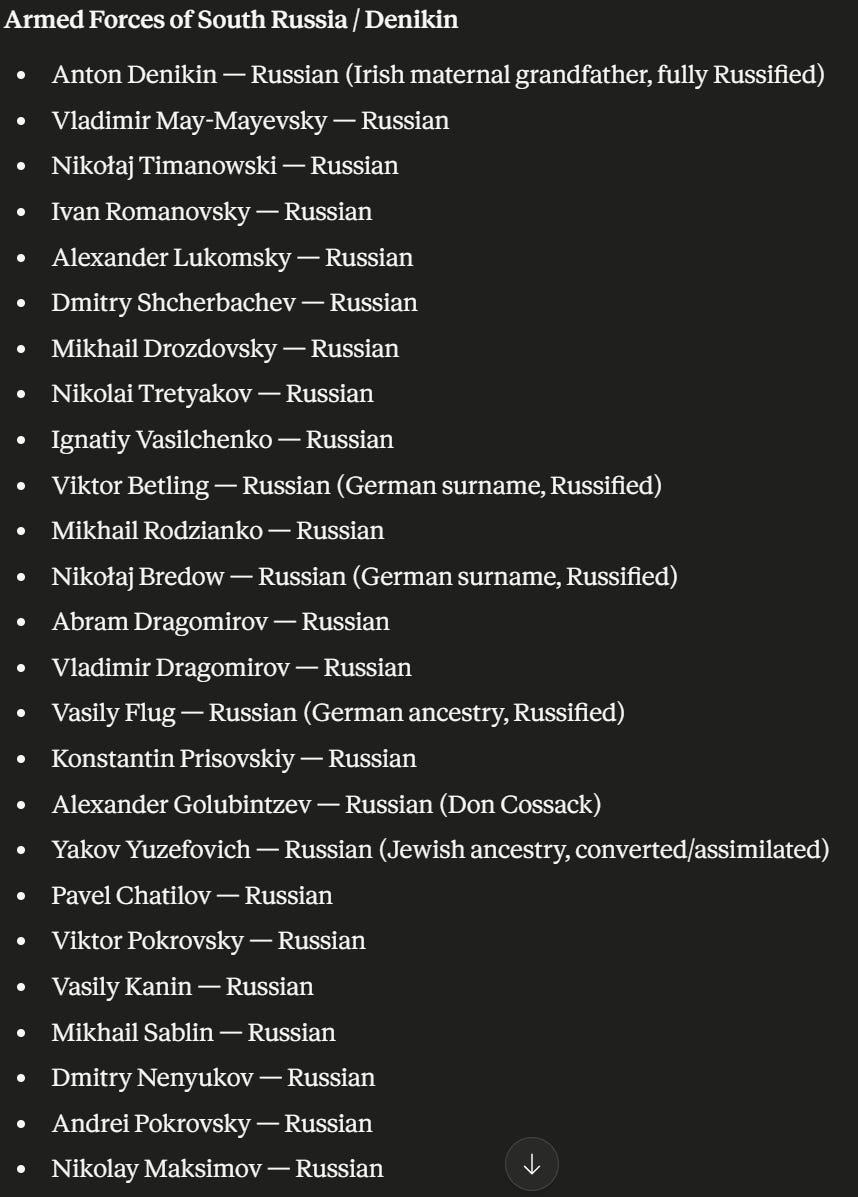
Still, the amount of Germans even if you include those with 1/4 German grandparents is 9% of the total. Consistent with Claude estimates of later Russian army being around 9% German.
The Government
Then I decided to look into the government, how many ministerial positions were occupied by Germans. For my methodology I decided to look at those who occupied the last ministerial position for any sphere:
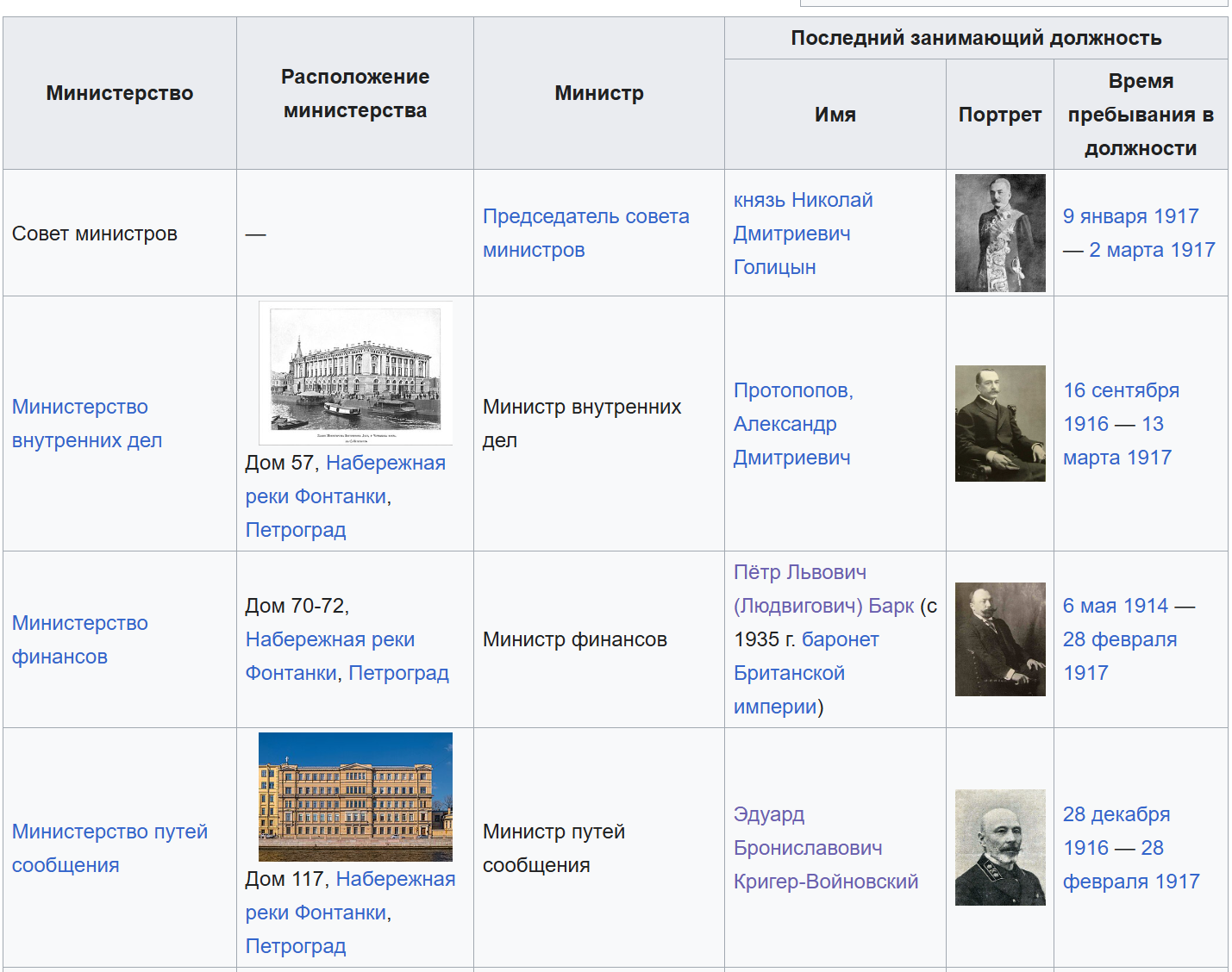
Nikolai Golitsyn - Chairman of Council of Ministers - Russian
Alexander Protopopov - Minister of Interior - Russian
Pyotr Bark - Minister of Finance - Half German, half Russian
Eduard Krieger-VoinovskyMinister of Railways - German, some Polish ancestry
Nikolai Pokrovsky - Minister of Foreign Affairs - Russian
Nikolai Dobrovolsky - Minister of Justice - Russian
Mikhail Belyayev - Minister of War - Russian
Nikolai Kulchitsky - Minister of Education - Russian of Ukrainian descent
Vladimir Fredericks - Minister of Imperial Court - Baltic German
Ivan Grigorovich - Minister of the Navy - Russian
Vsevolod Shakhovsky - Minister of Trade and Industry - Russian
Alexander Rittikh - Minister of Agriculture - Half German, half Russian
Georgy Ermolaevich Rein of Public Health - German surname, little info on family
Sergei Feodosyev - State Comptroller - Russian
Nikolai Rayev - Chief Procurator of the Holy Synod - Russian
Pavel Stakhovich - Head of State Stud Farms - Russian
Out of 16 ministers 5 were of German descent, though most of them were of partial German descent. If you break it down in terms of genetics, it will appear that indeed 20% of Russia’s ministers having German DNA.
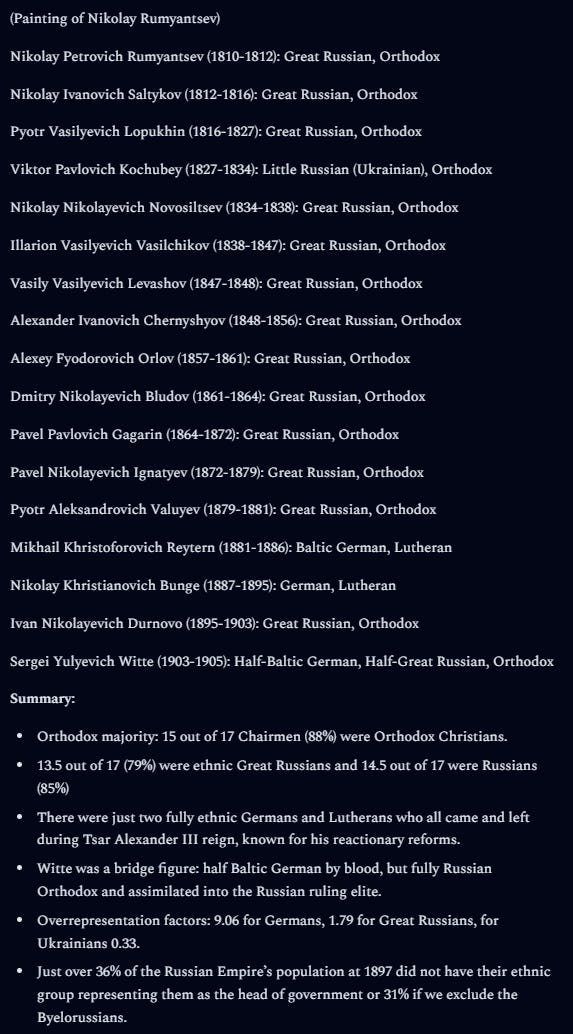
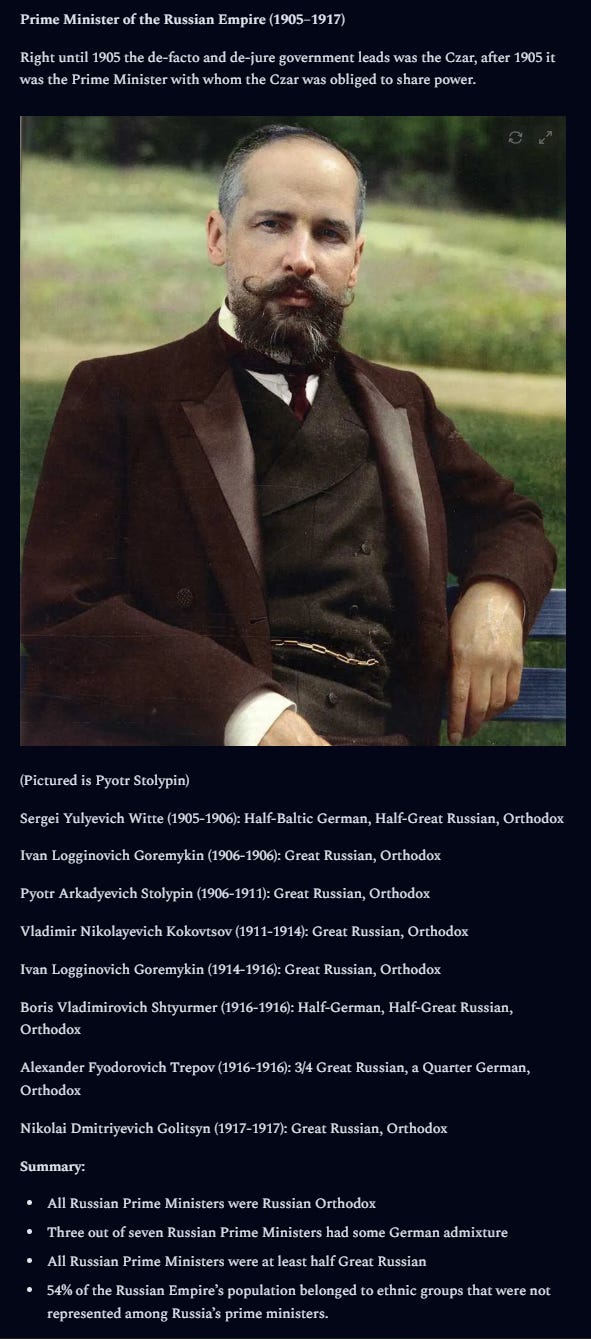
In my previous article I have estimated that people with German ancestry were in charge of the Russian government about 10% of the time.
Diplomacy
The next claim is the German overrepresentation among the Russian diplomats (which I have noticed myself)
Let’s start with the heads of the Russia’s foreign ministers:
Alexander Vorontsov 1802-1804 Russian
Adam Jerzy Czartoryski 1804-1806 Polish
Andreas Eberhard von Budberg 1806-1807 Baltic German
Nikolay Rumyantsev 1808-1814 Russian
Ioannis Kapodistrias 1816-1822 Greek
Karl Nesselrode 1814-1856 Baltic German
Alexander Gorchakov 1856-1882 Russian
Nicholas de Giers 1882-1895 1/2 Swedish 1/2 German
Alexei Lobanov-Rostovsky 1895-1896 Russian
Nikolay Shishkin 1896-1897 Russian
Mikhail Muravyov 1897-1900 Russian
Vladimir Lamsdorf 1901-1906 Baltic German
Alexander Izvolsky 1906-1910 Russian
Sergei Sazonov 1910-1916 Russian
Boris Sturmer 1916 1/2 German 1/2 Russian
Nikolay Pokrovsky 1916-1917 Russian
Out of 16 ministers 5 were of German descent and 3 were of full German descent. Funny enough if we look at the later stage of the Russian Empire it was noticeably less German. Genetically that’s about 25% Germanic.
For ambassadors I have decided to look at the last Russian ambassadors in major countries before the 1917 revolution:
British Empire (Chargé d'affaires) - Konstantin Nabokov - Russian
British Empire (Ambassador) - Sergey Sazonov - Russian
France - Vasily Maklakov - Russian
Italy - Mikhail von Giers - 1/2 Moldovan (possibly some German there) 1/4 Swedish 1/4 German
Spain - Mikhail Stakhovich - Russian
United States - George Bakhmeteff - Tatar (Christian)
Japan - Vasily Krupensky - Russian
Portugal - Pyotr Polikarpov - Russian
Switzerland - Ivan Efremov - Russian
Belgium - Alexander Nelidov - Russian
Netherlands - Nikolai Swerbeyev - Russian
Greece - Elim Demidov - Russian, symbolic Finno-Ugric descent
Serbia - Grigory Trubetskoy - Russian
Romania - Stanislav Poklevsky-Kozell - Polish
Sweden - Anatoly Neklyudov - Russian
Norway - Konstantin Gulkevich - Russian
Denmark - Matvey Sevastopulo - Greek
Argentina - Eugene Stein - Jewish
Persia - Nikolai von Etter - German
China - Nikolai Kudashev - Russian
Germans made only 6.25% of the total. That being said, I did a visual inspection of Russian ambassadors to these various countries and there was a lot of German overrepresentation to major countries like the UK, France and the United States in the middle of 19th century. Perhaps up to a third of all Russian ambassadors in major countries were of German descent, however in the early 20th century their influence has sharply fallen.
If you include the last Russian ambassadors to the Central Powers (1914) then here they are:
German Empire - Sergey Sverbeyev - Russian - (1912-1914)
Ottoman Empire - Mikhail von Giers - 1/2 Moldovan (possibly some German there) 1/4 Swedish 1/4 German - (1912-1914)
Bulgaria - Aleksandr Savinsky - Russian - (1913-1915)
Austria-Hungary - Nikolay Nikolayevich Shebeko - Russian - (1913-1914)
As you can see nothing really changes.
To test out my theory I decided to employ Claude to look at all Russian ambassadors to major countries in the 19th century (Italy, France, British Empire, United States, Germany, Austria-Hungary and Ottoman Empire), here are the results:
Germans = 27% of the total. Here is how this breakdown looks like by each country:
Austria-Hungary: Germans: 4 out of 16 = 25%
Germany: Germans: 4 out of 12 = 33%
United States: Germans: 5 out of 13 = 38%
Italy: Germans: 1 out of 5 = 20%
France: Germans: 2 out of 9 = 22%
British Empire: Germans: 5 out of 10 = 50%
Ottoman Empire: Germans: 0 out of 15 = 0%
Administration:
Finally, let’s look at the administration. After excluding Poland, Baltics and Finland here is who governed the provinces of the Russian Empire for 1914:
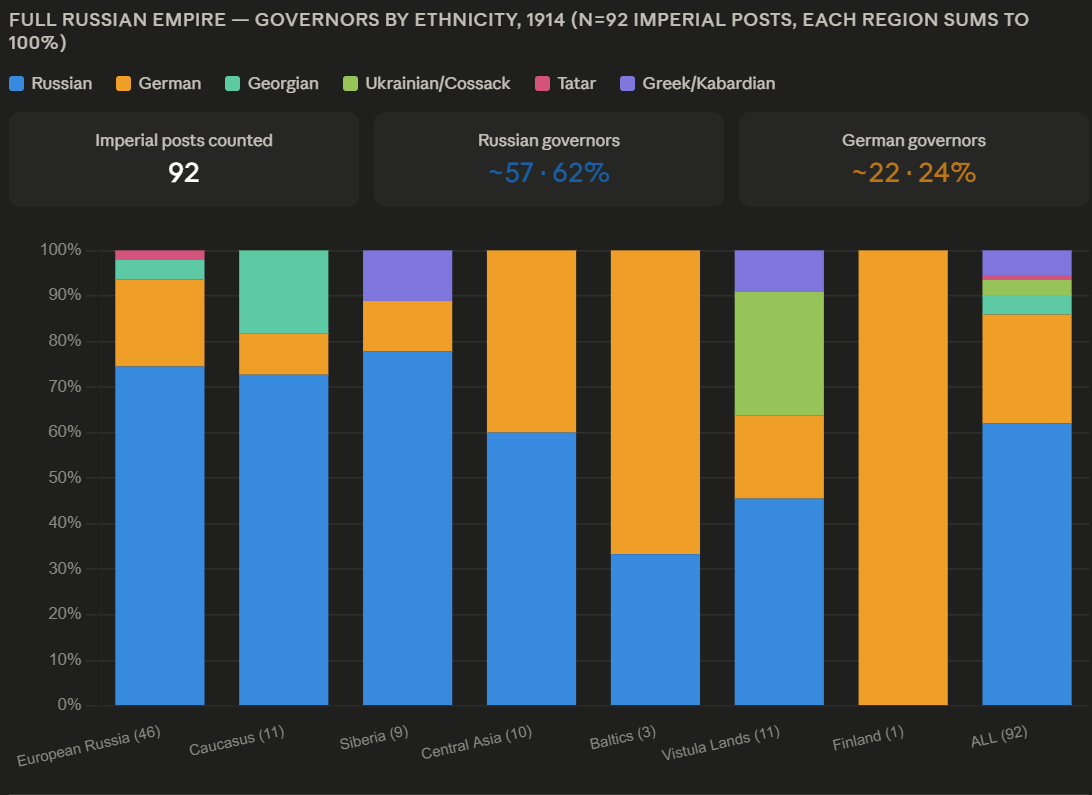
As you can see the German input is tremendous and like many other things you’re about to see. The only correction I’d make is add more Russian Cossacks like the governor of Kuban Oblast. Anyways, there is basically no other ethnic representation besides the Russian and the Germans as it relates to governing provinces. As I wrote on Twitter:
If you examine gubernatorial appointments in the Russian Empire, it becomes clear that the Russian Empire could be described as Great Russian and German supremacist state. Only Georgians and to a lesser extent Armenians managed to attain some positions within this hierarchy.
Germans made 24% of the total governors of the Russian Empire, although, much of it was concentrated in the Baltics, Central Asia, Finland and Vistula. The European part of Russia in which the Germans reigned over was mostly territories of the Ukraine and Belarus.
Nonetheless, the Russians and the Germans have effectively co-ran the Russian Empire’s administrative borders at the exclusion of everybody else with some minor caveats.
Parliament (State Duma):
Thankfully there is a research article on this topic already so I don’t need to do extra research myself.
All the people of Russia acquired the right to present their
interests during the elections and in the Duma, to form nationally-based
political elites and to master parliamentary political culture.
However, only four deputies of the First State Duma were registered
as Germans. They all represented immigrant communities: Andreas
Widmer, a Lutheran farmer, deputy of a district zemstvo (local government)
assembly in Bessarabia province; Ivan Minkh, the Lutheran headman of a
German colony in Kherson province; another Lutheran, Jacob Dietz, a
lawyer and journalist from Saratov province; and Heinrich Schelhorn, a
parish foreman, owner of a printing house and deputy of the provincial and
district zemstvo assembly of Samara province.
In other words, out of 477 deputies, Germans amounted to just 4 or 0.84% of the total. This means that Germans were actually underrepresented in the one institution selected by something resembling a democratic franchise.
Anyways, I did some extra digging myself and found a list of all the deputies in the Russian Empire’s State Duma. Looking into the Fourth State Duma (1912-1917) specifically, here are the results:
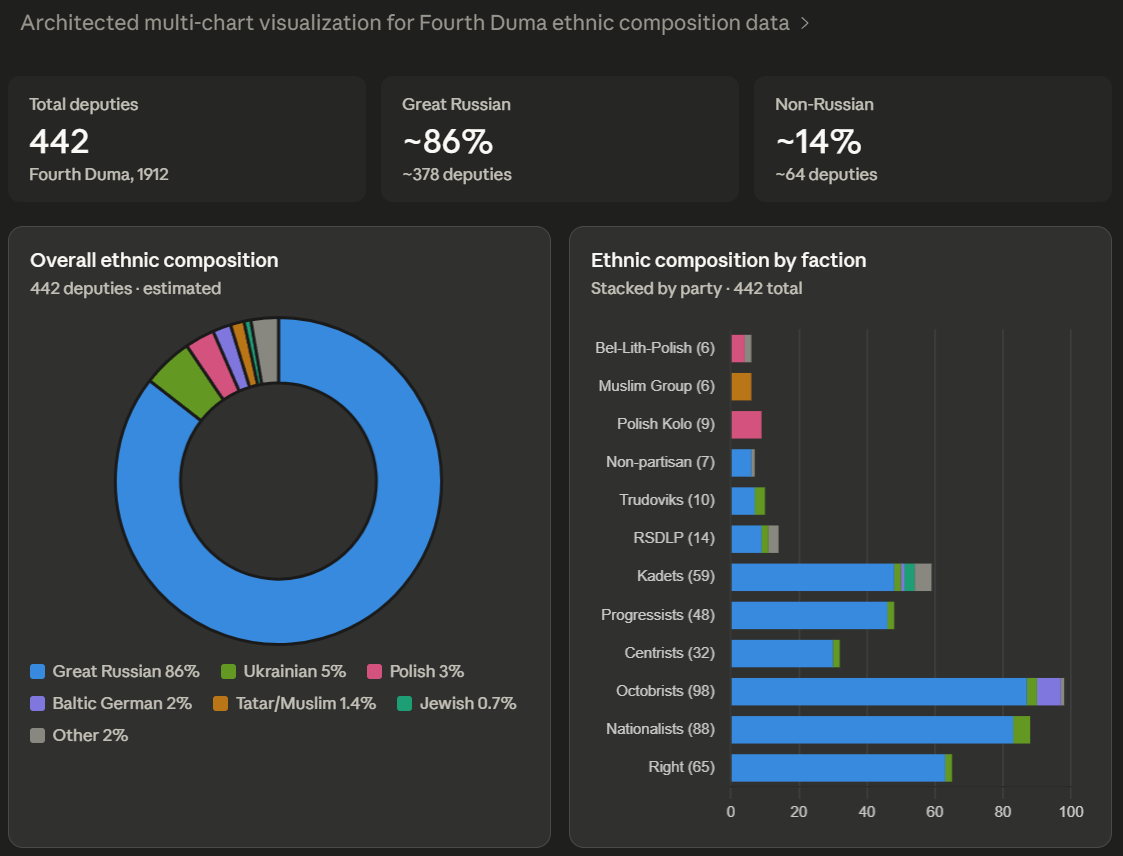
As you can see, the Russian parliament was a Russian-dominated space. Germans amounted to just 2% of the total and overwhelmingly belonged to the Czarist Octobrist party.
Finally I decided to go with the 1917 Russian Constituent Assembly election after the Czarist regime lost power and here are the results of the first Russian election with universal suffrage:
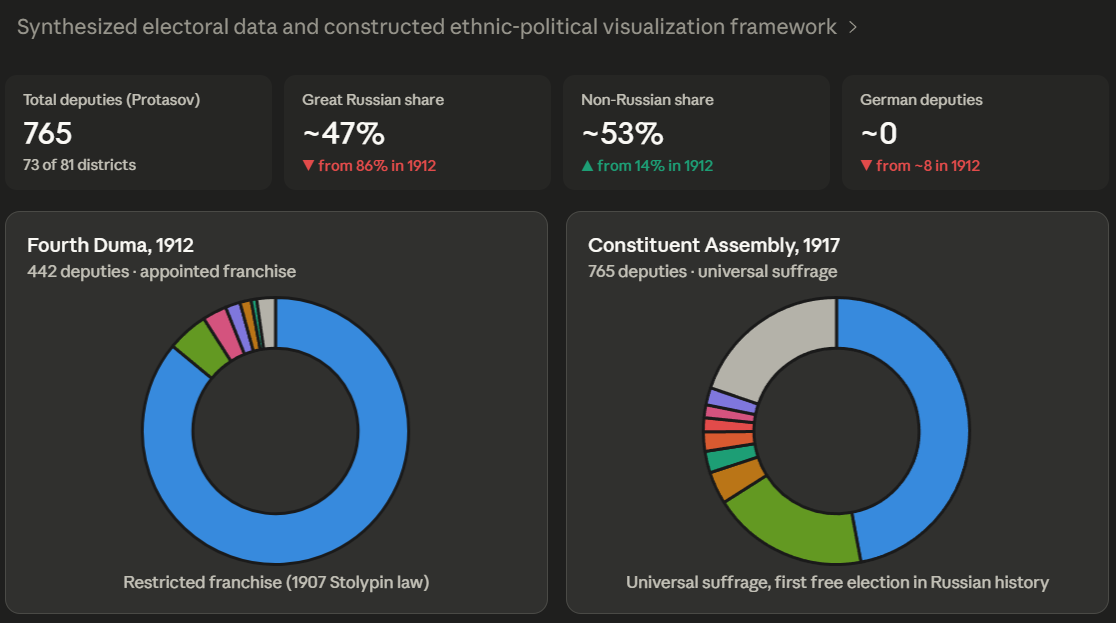
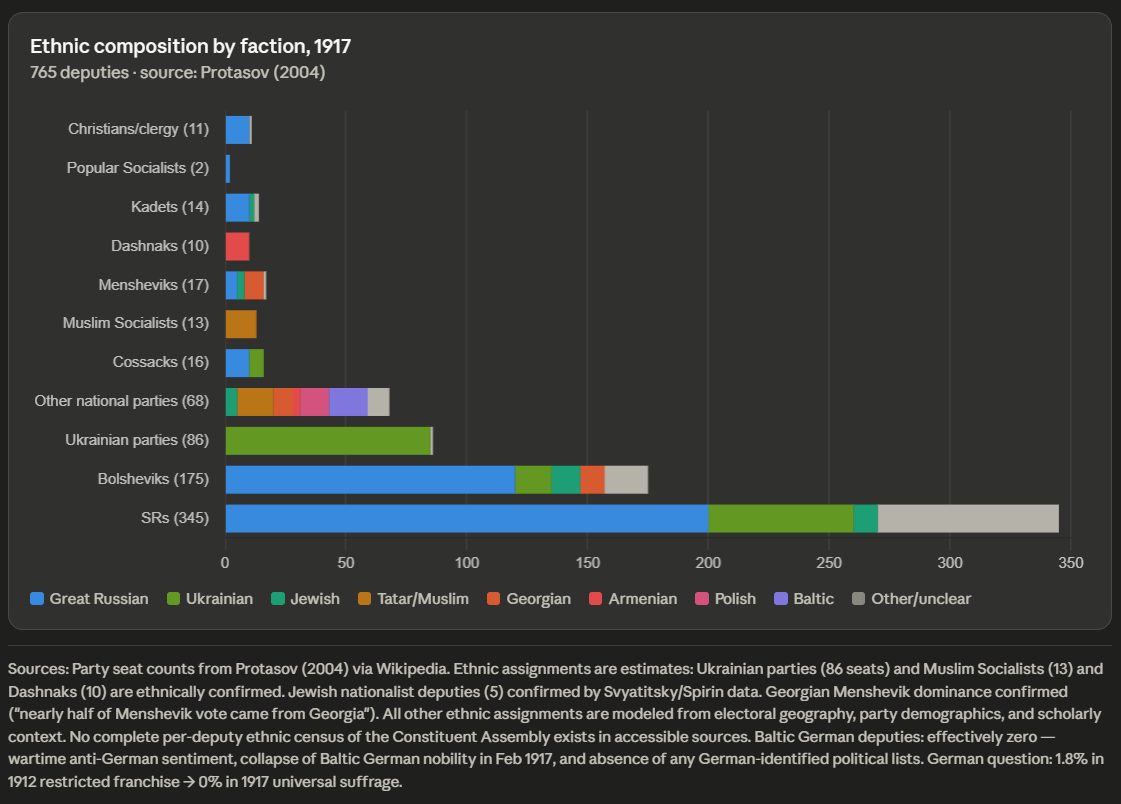
As you can see both the Germans and the Russians took a heavy hit from the universal suffrage. But the Germans were completely wiped out.
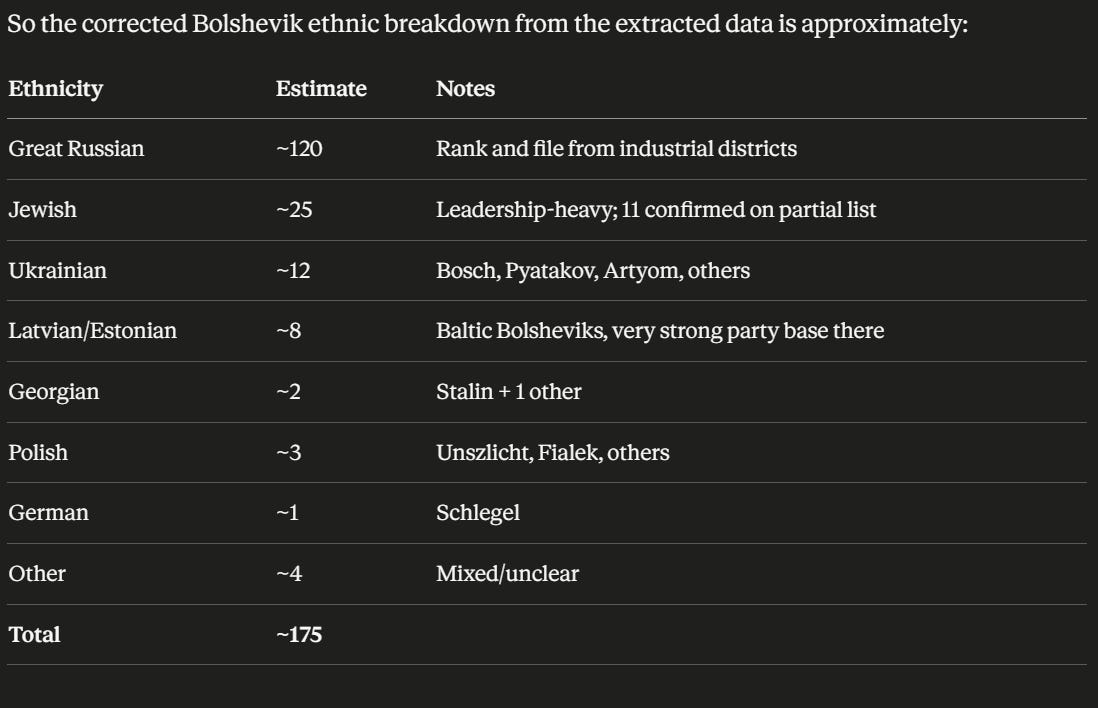
I also challenged Claude on the Jewishness of the Bolsheviks and this is the results:
Cultural and Spiritual Life
German Writers
Thankfully I don’t need to conduct new research because I have already done an ethnic and religious study of the greatest Russian writers of all time and by Russian I mean writers from the Russian Empire and as I have determined Germans were not represented at the early stages of the Russian Empire yet they were not particularly overrepresented at the later stages of the Russian Empire either. For the most part, German overrepresentation means that one or two Russian writers were one eight or one quarter German themselves. Nonetheless here is the data:
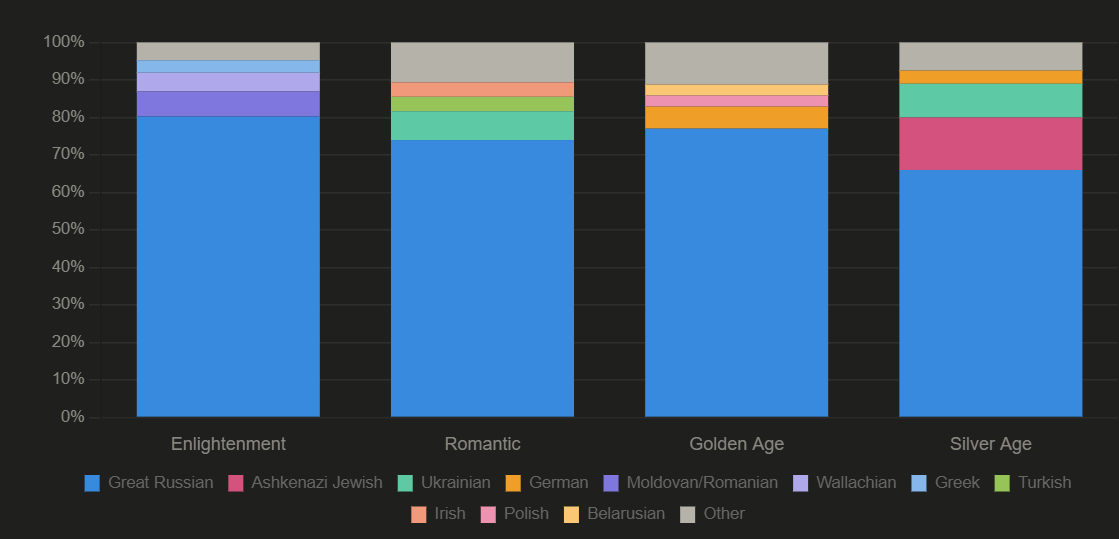
German DNA made about 5.88% of Russian writers and poets of the Golden Age Era and 3.5% of the Silver Age Era. However the Russian Empire did not produce a single well known German writer.
Classical Music:
