

In the popular imagination Nietzsche’s idea of the slave morality is equated to following the egalitarian Christian moral teachings which he saw as the morality of the weak, coping against the strong.
Slave morality is a system of values in which the weak have created out of ressentiment caused by them not being able to defeat the strong in reality and so as a coping mechanism they labelled master’s values as evil, while branding their own values as virtuous.
This is partially, true and the emotional mechanism of bringing down the strong out of envy has scientific backing. Heck, we even have entire ideologies dedicated to it!
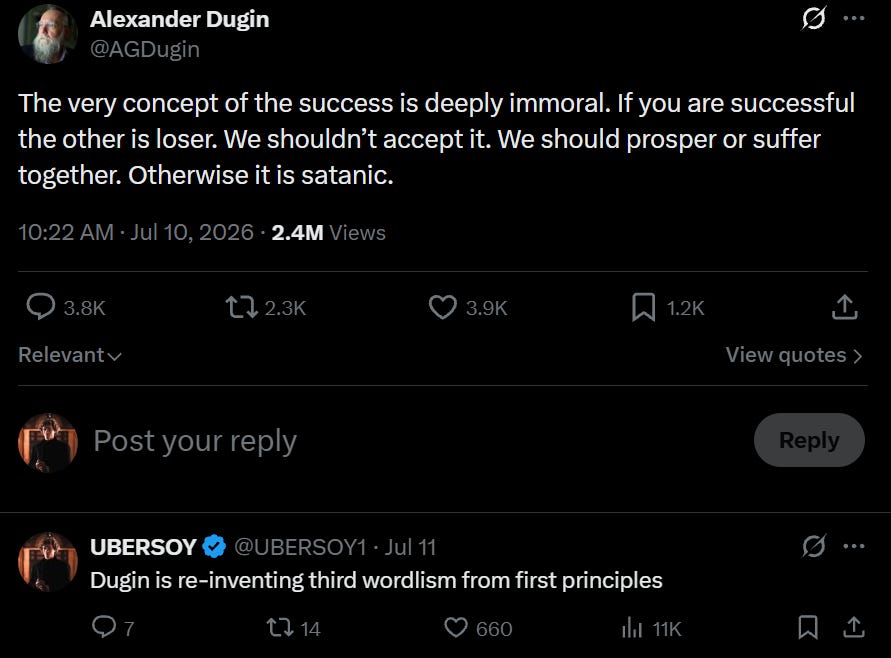
But it’s not as easy as Nietzsche put it. Most of the status conflicts are horizontal, they are not between superior and inferior, but are rather between peer and peer. Rivalry is most highly concentrated among peers, not among distant people.
Certainly, egalitarianism is an evolutionary strategy of maintaining social harmony and the weak balancing out their interests against the strong. That is not disputed in the evolutionary anthropology and envy is a valid evolutionary strategy, although itis not just envy, it is primarily a need for autonomy.
But this is not what I want to talk about, because people who are regarded as “masters”, at least in our world don’t necessarily act as master supremacists, they typically adopt the “slave morality” in order to be pro-social. On the other hand, typically it is the ultra-right wing chudcels who find themselves among those with a poor status.
It is in almost everyone’s experience that the strong tend to adopt the slave (popular and egalitarian) morality at least politically and socially while the weak are more diverse in their political views. Both keep their respective status.
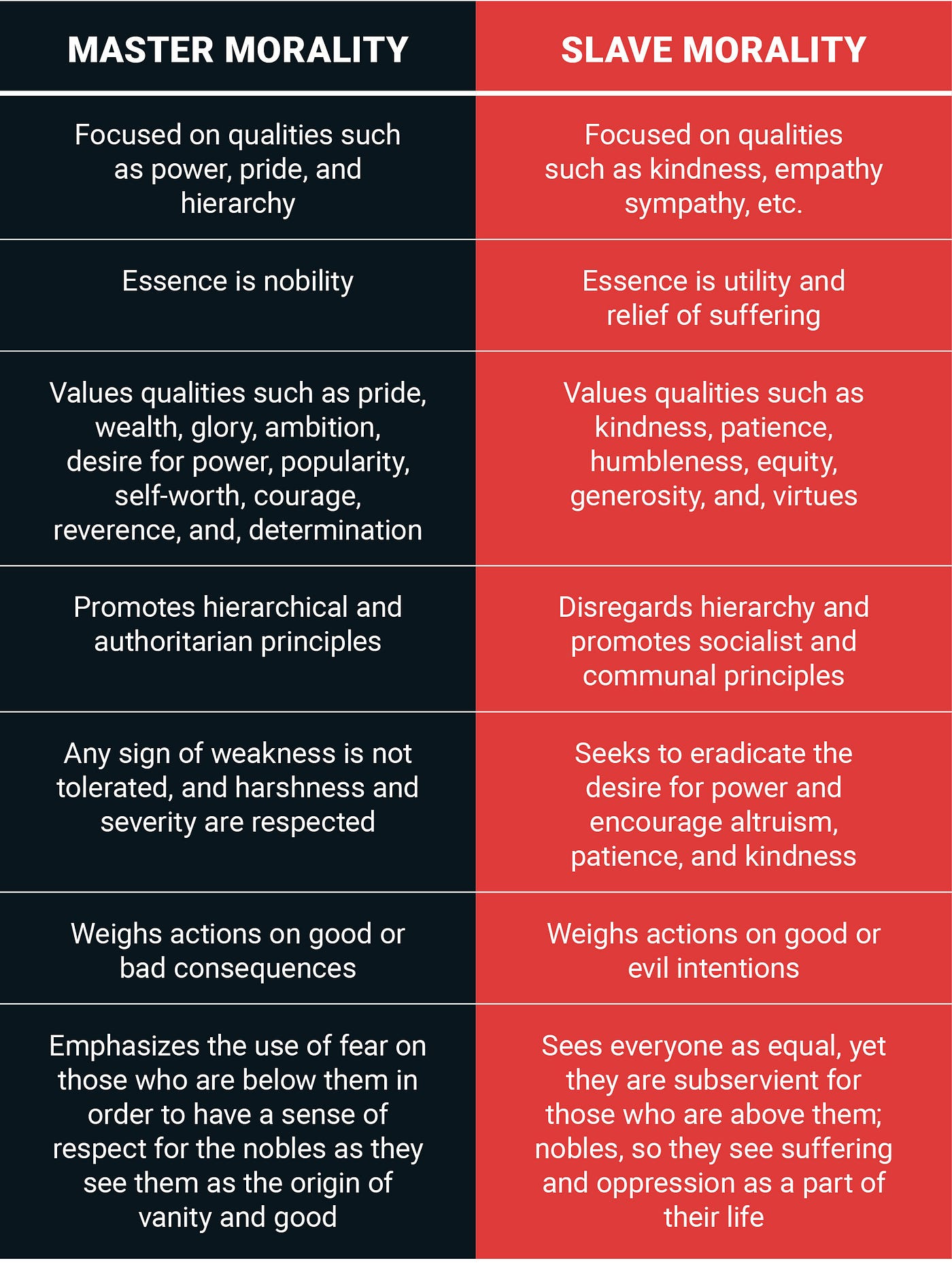
Empirical data likewise confirms this, actual status predicts slave morality: the more educated and higher-IQ you are, the more reliably you profess egalitarian, prosocial, anti-hierarchy values (with some caveats like the economic axis and what you are about to read on in the following segment).

People who comprise our elite tend to hold many of the resentful attitudes towards their own population (if they happen to be White), and so the adoption of these “slave” views come from the position of a master ironically enough. A good counter argument is that the elite is not thinking in terms of kin, but view themselves as trans-national and a class-based moral identity group and are willing to use force and threat against their right-wing enemies who are trying to challenge their status.
The relationship is likewise a little bit complicated because a lot of these pronouncements are virtue signaling, and some of elite pronouncements are not carried through the master’s own daily life. The most famous one is children out of wedlock: only 10% of college-educated births are out of wedlock against 62% at the bottom.
Another famous one is about progressives who campaign against private-school but are sending their own children there along with about half of America’s politicians. Dick Durbin most famously killed the D.C. Opportunity Scholarship voucher program for poor kids while sending his own children to a private school and having attended one himself. Some very smart people have labelled this phenomenon as luxurious beliefs.
This certainly reminds me of the Jews (true carriers of master morality) who are supportive of far-left morality for the outgroup while supporting far-right morality for themselves. This is advantageous for them to do from a group evolutionary strategy standpoint.
What is the difference between real behavior and professed? As I wrote in my other article:
In a recent, highly publicized study by Michael Zakharin and Timothy C. Bates, higher intelligence was found to be negatively correlated to both binding (r=-.24) and individualizing (r=-.19) moral foundations.
But is it related to the slave-master dichotomy? Because religion is a big part of deception, with its adherence causing almost no impact on life outcomes (at least among the vast majority of Christians).
This brought me to the realization that, like on many other issues, Nietzsche only saw a part of the picture.
